
Pierre Jeanneret and the Furniture of Chandigarh
What these pieces are, why they matter, and how to tell an original.
Table of Content
A city built from scratch
In 1951, the Indian government commissioned Chandigarh, a new capital city for the state of Punjab, built from open ground at the foot of the Himalayas. The assignment went to Le Corbusier. His cousin Pierre Jeanneret came with him and stayed until 1965.
While Le Corbusier designed the civic monuments, the High Court, the Assembly, the Secretariat, Jeanneret ran the day-to-day. He oversaw construction, managed the local workshops, and designed everything that went inside: the desks, the chairs, the bookcases, the stools, the bedside tables. Every piece of furniture for every university, hospital, law court, college, and hostel in the new city passed through his office.
The furniture was designed in Jeanneret's office and built in Chandigarh's workshops from solid teak and, more rarely, sissoo, the Indian rosewood, produced in the thousands and distributed across dozens of institutions throughout Punjab. Each institutional piece was stencilled with a code identifying its building and department, logged in registers kept by each administration.

Why these pieces are collected
THEY ARE HISTORICALLY DOCUMENTED


Each stencil links a piece to a specific building, its department, and sometimes its year of supply. Read one and a room appears. The High Court bookcase in our collection reads HC/CH/SF.DIV/
Rs37/1962: High Court, Chandigarh, Steno-Filing Division, 1962. The Rs figure is read as the piece's value in the court's register, thirty-seven rupees at supply. The Capitol Complex it served was inscribed as a UNESCO World Heritage Site in 2016. The provenance is legible on the object itself. Our pair of bedside tables carries room numbers from neighbouring hostel rooms, 117/C and 118/C. They came out of adjacent rooms and they remain together now.
THEY ARE BUILT TO LAST
Solid teak throughout, built for institutional use in a hot climate and decades of daily handling. The pieces that have reached us were in continuous service from the 1950s and 1960s onward. The patina is more than sixty years of honest wear.

THE DESIGN HOLDS
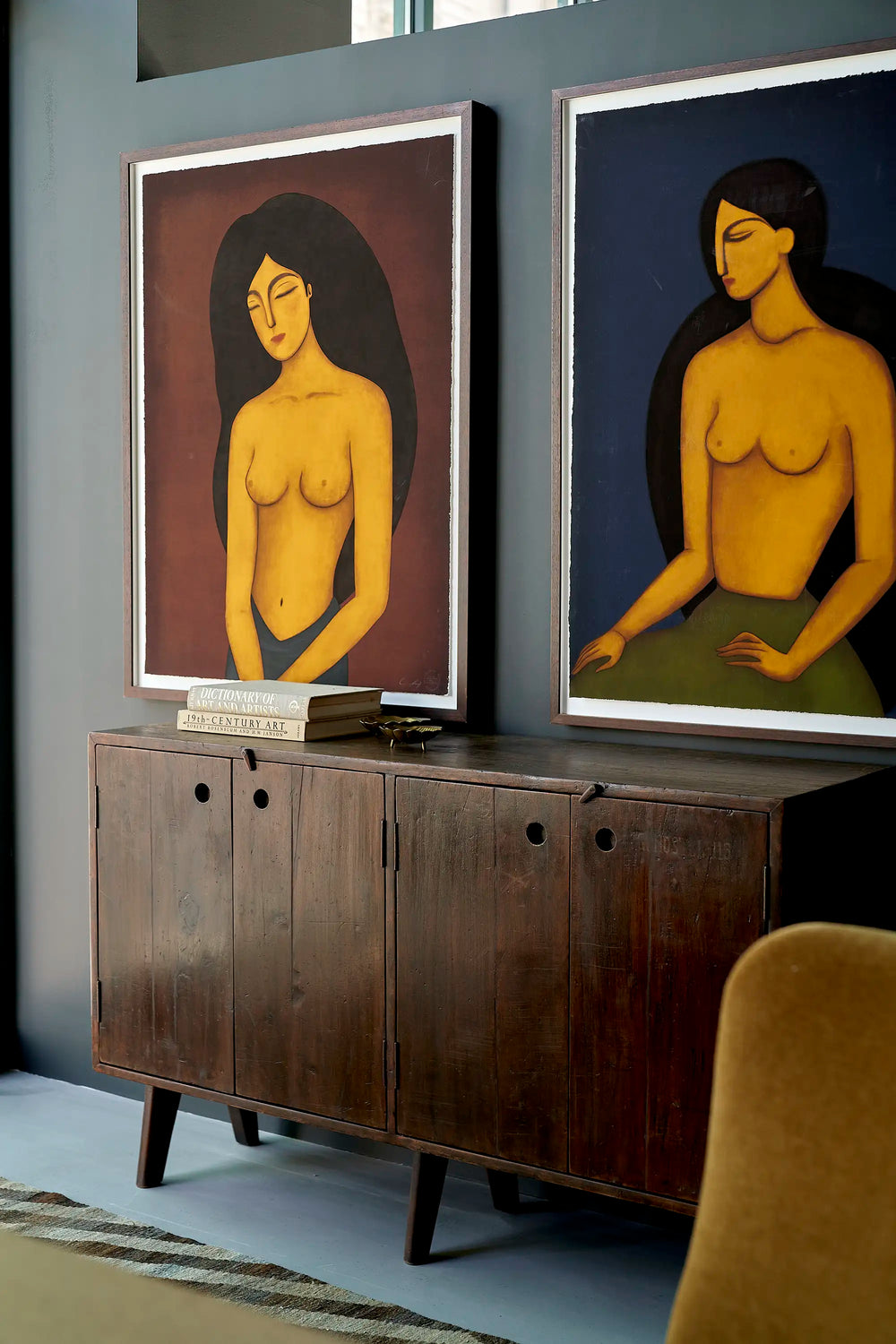
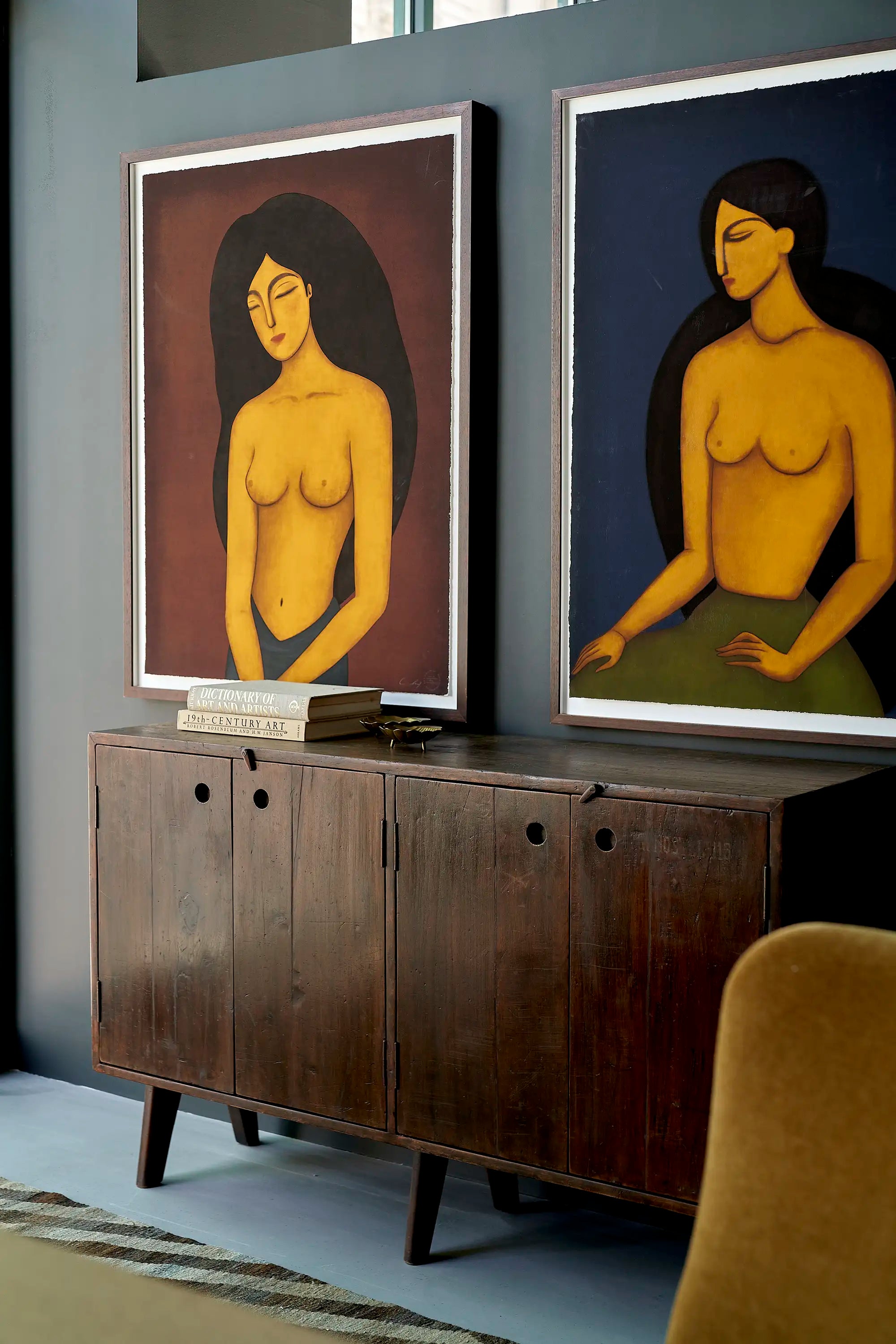
Jeanneret worked beside the people who defined the modernist canon. Charlotte Perriand shared the Le Corbusier-Jeanneret studio on rue de Sèvres for a decade; Jean Prouvé was active in the Resistance and collaborated with him on prefabricated housing during and after the war. The forms are reduced to their structural logic: X-legs, compass frames, open shelving, circular drawer pulls routed straight into the wood. These pieces sit well in contemporary interiors because they were never following a trend.

THE SUPPLY IS FINITE
Chandigarh's institutions have been shedding Jeanneret furniture for decades, and the international collector market has absorbed most of what came out. Pieces with clear stencils from the Capitol Complex, the High Court, and the university campuses are genuinely hard to find now.
How to tell an original
The stencil. A clear, correctly formatted institutional code is the strongest single indicator.
The wood. Solid teak, or more rarely sissoo, on every surface. Turn it over; the underside should look like the front.
The joinery. Mortise and tenon, dovetails, wooden pegs. Screws in the structure are a warning.
The weight. Solid teak is heavier than it looks. Light for its size is a warning too.


The stencil
Institutional pieces carry a stencil, painted or stamped directly onto the wood, typically on a back panel, apron edge, or leg. The format is consistent: an abbreviation of the institution, a department or building code, then a number.
The wood
Original Chandigarh pieces are solid wood on every surface, including backs and undersides: teak most often, with sissoo, the rarer Indian rosewood, on some. Reproductions commonly use veneer over a cheaper substrate, or a different wood entirely.
The joinery
Jeanneret's workshops used mortise and tenon, dovetail drawer construction, and wooden pegs and wedges at structural joints. You should not find screws in the primary structure of an authentic piece. Any screw you find was added later, usually by an institution making repairs.
The weight
Solid teak is heavier than it looks. A genuine Jeanneret stool weighs more than you expect when you pick it up. If a piece feels light for its size, pay attention to that.
"The stencil is the piece's biography, written directly onto the teak in the institution's own hand."
The pieces currently available
All pieces offered by Lemieux et Cie are authenticated vintage originals acquired directly from Chandigarh and the surrounding Punjab region. Each is condition-documented with a full photographic record and offered as found, lightly cleaned and unrestored.
See the collection
Jeanneret left India in August 1965 and died two years later in Geneva. In April 1970, at his request, his niece carried his ashes back to Chandigarh and scattered them over Sukhna Lake, the reservoir where he had spent his weekends building sailboats. He wished to remain part of his creation. The furniture he made for the city was designed to serve a young democracy's daily work. It still serves, differently now, and the white letters on the teak say exactly where it has been.
The Pierre Jeanneret collection is on view at 161 Grand Street, SoHo. Individual piece documentation is available on request. For questions about provenance, condition, or specific pieces, contact the showroom.
Recent Edits